Sampurna

Jal

Introduction

As we are heading towards a progressive world, we are facing issues related to global warming. Mother Earth sustains one and all, but now the crown jewel, water, is at stake. Just like how well-being of the woman is important for the well-being of the entire family and society, water is essential for the survival of humanity. If a natural resource such as water becomes scarce, it would shake the very foundation of our lives. Water bodies are important tool to keep our Mother Earth healthy & green.

Jal

The reality of dying water bodies is known to everyone. The fact is this that the capital of India, Delhi has no source of water. The water bodies of the past are left on the mercy of the land mafias. The work needs to be done immediately, or else we would end up with a water crisis on our hands.

Our Hon'ble Prime Minister Shri Narendra Modi Ji has announced a new initiative named ‘Mission Amrit Sarovar’. The Mission is aimed at developing and rejuvenating 75 water bodies in each district of the country, as a part of celebration. His idea is to replenish the ground water, conserve the water for human life. ‘Sampurna’ would like to extend support firstly through awareness on water and secondly by ensuring community participation for reviving the water bodies.

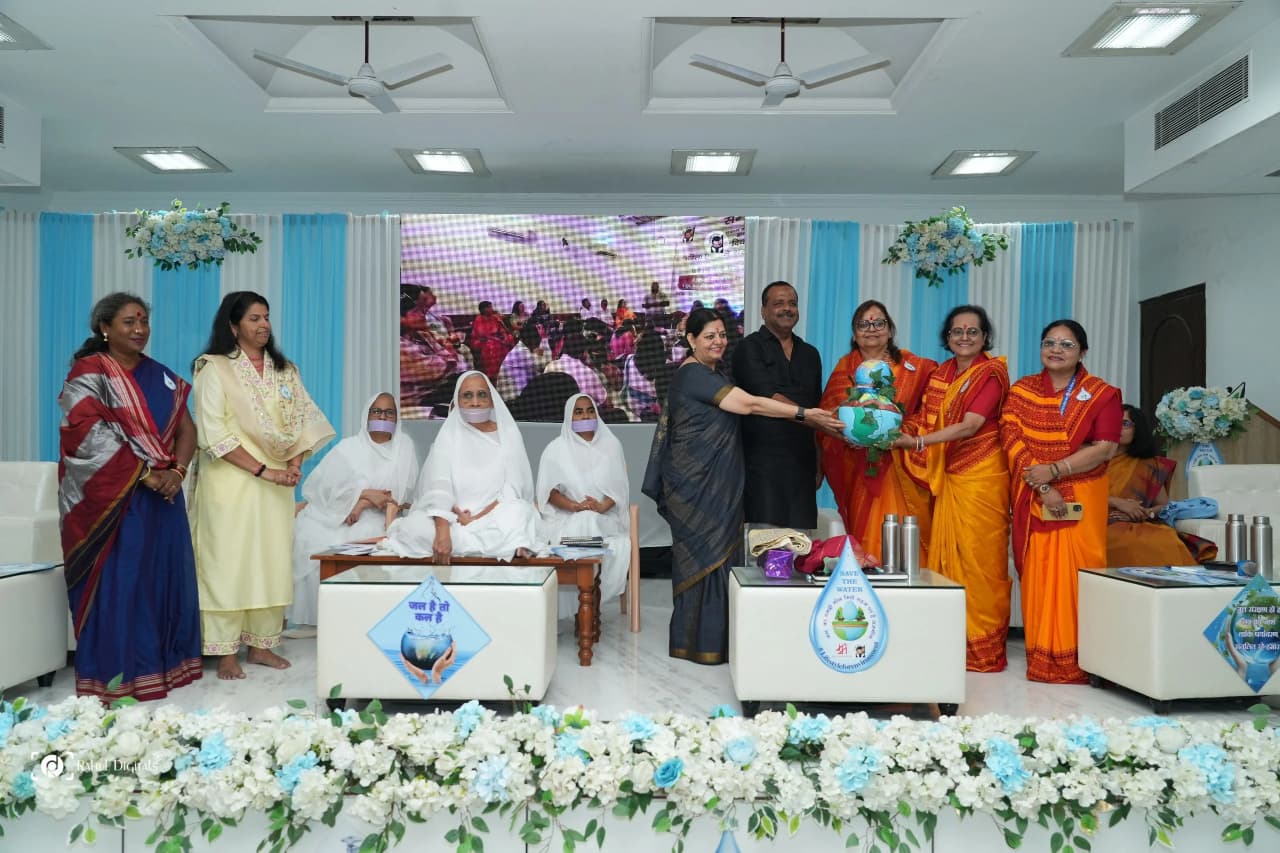
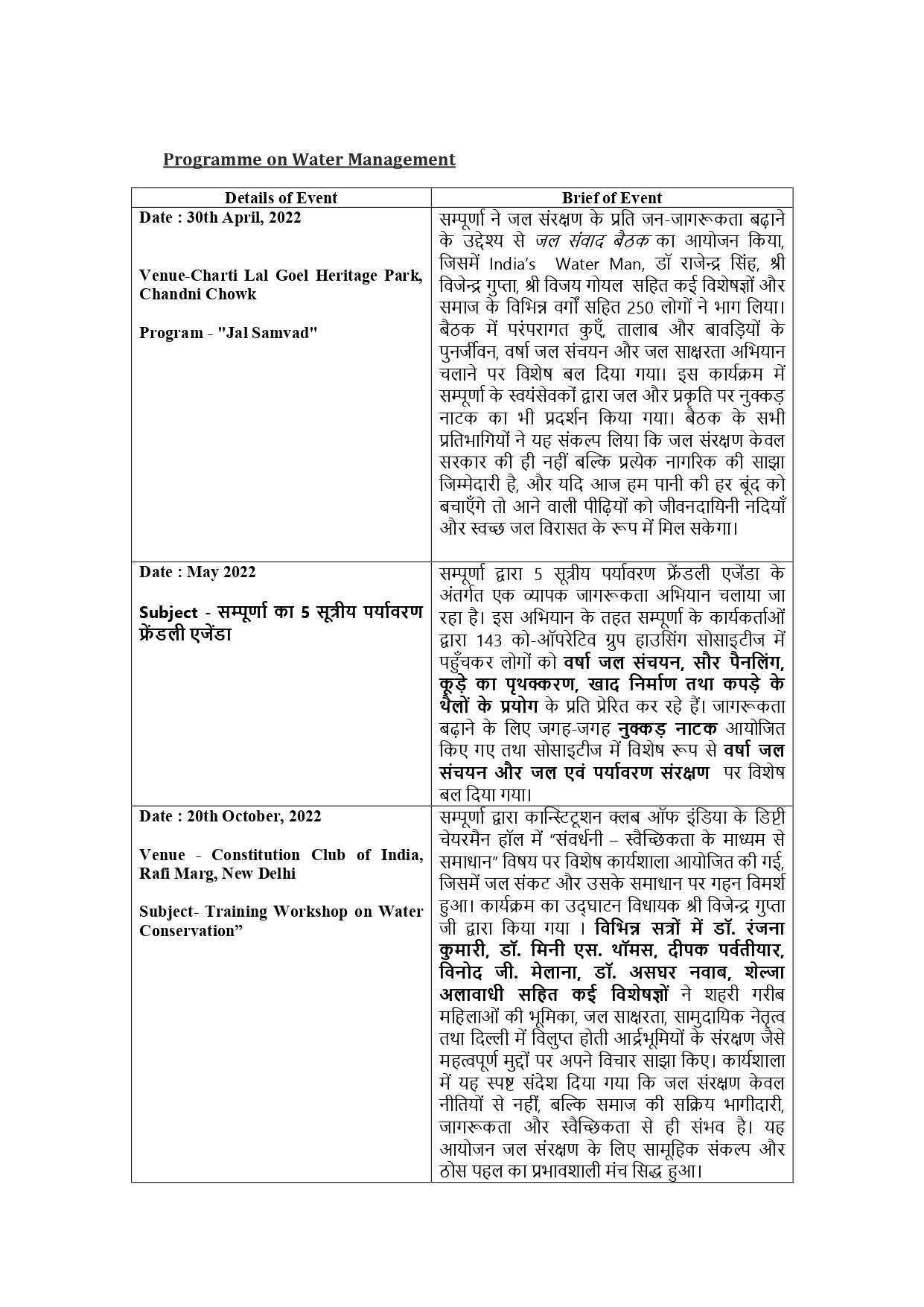
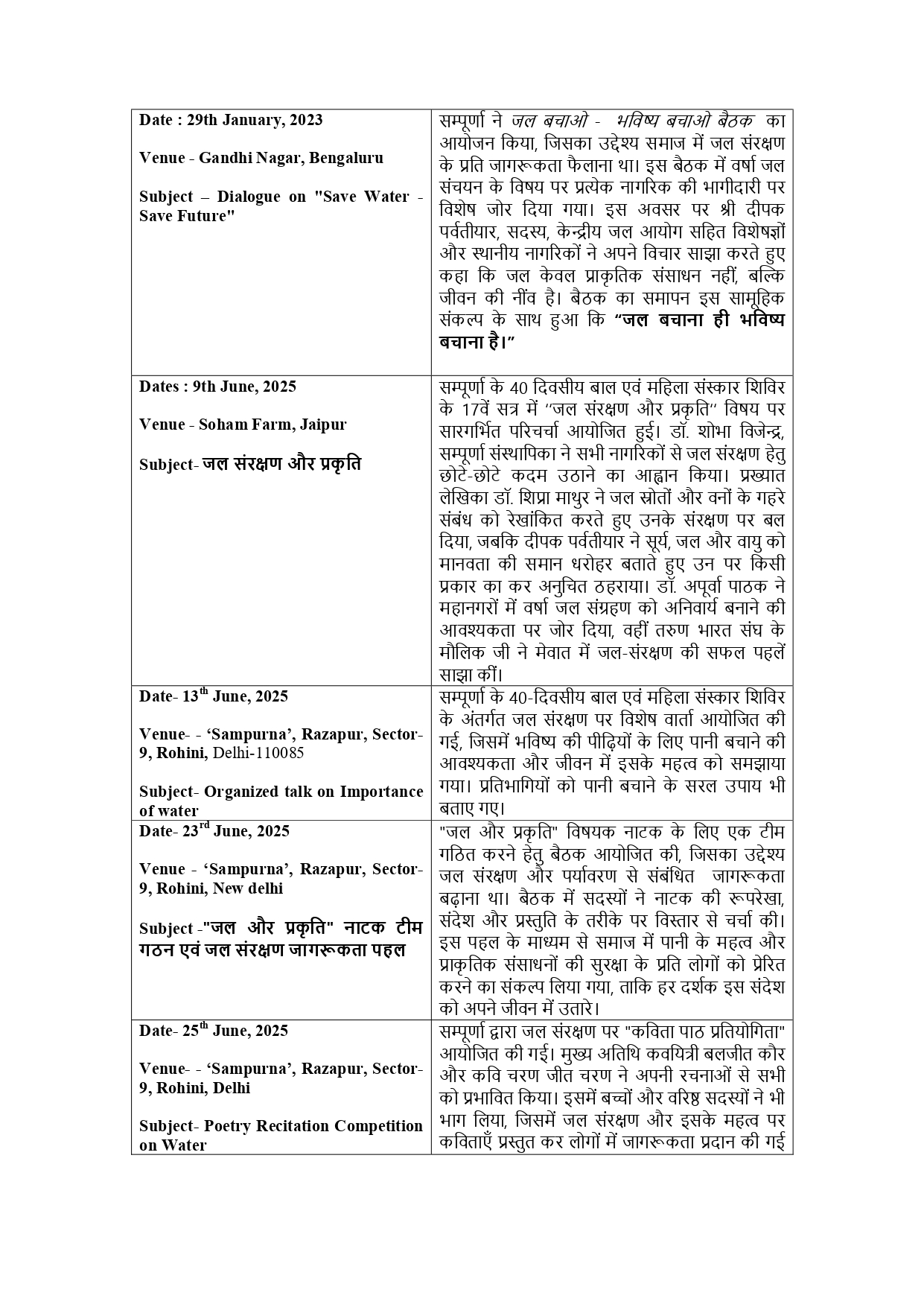
‘Sampurna’ is venturing out to create awareness about water literacy and the issues since 2015. The event named as ‘Jal Sakhi’ reinforcing its long-standing commitment to water literacy, conservation, and sustainability.

Role of Women in Water

Women and Water: Empowering Women to Lead the Way Towards Water Sustainability

Water is a fundamental resource for all living beings, and its availability and accessibility have a profound impact on human lives. However, in times of water crisis, women often find themselves at the forefront of the struggle for water, bearing the brunt of the burden. Whether in urban, rural, or tribal areas, women are tasked with the responsibility of fetching water for their households. While privileged or wealthy women may have the luxury of assistance, the majority of women face the same arduous journey. In urban slums,women wait for water tankers, waking up early and enduring fights over limited resources. In villages, women trek long distances to fetch water, and in remote tribal areas, the challenges are even greater. It is high time to address this issue and empower women to become water literate, encouraging them to take action to conserve water in their homes and lead a broader social movement to transform behaviors and attitudes towards water.

The Water Crisis and Women's Suffering:

The world is facing an escalating water crisis, and women are among the most affected. In many parts of the world, it is primarily women who bear the responsibility of water collection, as cultural norms and gender roles often dictate these duties. The daily struggle to obtain water becomes a daunting task, impacting women's time, health, and overall wellbeing. The physical labour and time spent on water collection limit their opportunities for education, economic empowerment, and personal development. Additionally, the lack of access to clean and safe water affects women's health, as they are more susceptible to waterborne diseases due to inadequate sanitation facilities. The inequality and suffering women face due to water scarcity and lack of access are clear indicators of the urgent need for change.

The Power of Water Literacy:

Water literacy is not just about understanding the importance of water; it is about empowering women to take charge of their water resources and initiate sustainable practices. Every woman has the potential to become a catalyst for change within her own household and community. By fostering water literacy, women can learn practical ways to conserve water, such as efficient water use, rainwater harvesting, and wastewater management. They can also raise awareness about the value of water, influencing behaviors and attitudes towards its conservation. Water literacy equips women with the knowledge and skills to not only address immediate water challenges but also adapt to future uncertainties and ensure long-term water security.

The Role of Women in Transforming Social Behavior:

Women, being intimately connected to nature and their communities, have a unique perspective and inherent strength to drive change. By harnessing this power, they can lead a social movement focused on water conservation and sustainability. This movement begins at the individual level, with each woman taking responsibility for saving water in her own home. Simple actions such as fixing leaky taps, using water-efficient appliances, and practicing responsible water use can have a significant impact when multiplied across communities. Women can also organize awareness campaigns, workshops, and community engagement activities to promote water literacy and create a collective understanding of the importance of water conservation.

Learning from Cape Town's Water Crisis:

The water crisis in Cape Town, South Africa serves as a stark reminder of the consequences of neglecting water conservation. The city faced the looming threat of "Day Zero," where taps would run dry, and residents would be left without access to water. The crisis was a wake-up call for the world, demonstrating that any major city, including those in India, could face a similar fate. Women, as natural caregivers and guardians of their families' well- being, can take the lead in preventing such a scenario by driving behavioral change and advocating for sustainable water management.

The Way Forward: Empowering Women for Water Sustainability:

To address the complex issue of water scarcity and inequality, several steps can be taken to empower women and ensure water sustainability:

  1. Education and Awareness: Governments, NGOs, and community-based organizations should prioritize water education programs targeted specifically at women. These programs should provide practical knowledge about water conservation, sanitation, and hygiene practices, empowering women to make informed choices.
  2. Access to Resources: Women must have access to safe and clean water sources within a reasonable distance from their homes. Governments and organizations should invest in water infrastructure, including piped water supply systems and community-level water management initiatives.
  3. Gender-Inclusive Policies: Policies and programs related to water management and conservation must integrate a gender perspective, ensuring women's active participation and decision-making in water-related matters.
  4. Capacity Building: Training and capacity-building programs should be developed to enhance women's skills in water management, including rainwater harvesting, water purification, and water-efficient practices.
  5. Advocacy and Collaboration: Women should be encouraged to participate in local, national, and international forums to advocate for water sustainability and highlight the importance of gender-inclusive water policies.

Conclusion:

The issue of women and water scarcity is a pressing concern that requires urgent attention and action. By empowering women and promoting water literacy, we can transform the current narrative, where women are disproportionately burdened by water-related challenges. Every woman has the potential to be an agent of change, driving sustainable practices within her household and community. By fostering a collective movement, women can transform social behavior, creating a future where water is conserved, accessible, and equitable for all. It is time to recognize the power of women in shaping a sustainable water future and work together to ensure a world where no woman suffers due to the lack of this precious resource.
White Paper on Water Bodies
Dated 06 April, 2023
Delhi Waterbodies Rejuvenation
A white paper on rejuvenating the waterbodies in Delhi

Introduction

Delhi is facing severe water crisis and pollution issues. The waterbodies of the city are a vital resource for its growing population, providing water for drinking, irrigation, and ecological balance. Unfortunately, many waterbodies have been encroached upon or mismanaged due to a lack of coordination between the central and state governments, as well as inadequate community engagement

Out of the 1043 waterbodies identified through geo-mapping, many are encroached upon or in a state of disrepair. The government's efforts to rejuvenate these waterbodies have been insufficient, with slow progress made so far. Moreover, the local community has not been effectively involved in the restoration process, limiting the potential for sustainable change.

According to the Delhi Wetland Authority, there are 1043 water bodies in Delhi, out of which 258 are encroached upon. Additionally, 37 water bodies have not been identified at all even by geo-tagging. It means that out of the 1043 water bodies, only 650 are potentially available for rejuvenation efforts. In the first phase of the revival project, the Delhi Government has identified 250 water bodies and 15 lakes for rejuvenation. Only 26 water bodies have been rejuvenated so far, as per a report. *1

On the other hand, the Central Government has completed 80% of the work to rejuvenate water bodies in India and has completed work on 40,000 water bodies across the country.*2 Certainly! The Prime Minister of India has launched an initiative to rejuvenate 75 water bodies in each district across the country. This is a commendable effort that has the potential to bring about numerous environmental and health benefits. However, it is concerning that some states and union territories, including Delhi, have been slow to take action and are not giving the initiative the attention, it deserves.

To make this initiative a success, it is crucial for there to be active community participation and strong political will at all levels of government. Local communities must be mobilized and engaged in the process to create a sense of ownership and responsibility. This can lead to more sustained efforts towards rejuvenating the water bodies.

The Central Government has provided funds to support the initiative, but it is important for state Government to use these funds effectively and ensure that they are being used towards the intended purpose of rejuvenating water bodies. This can be achieved through effective planning, implementation, and monitoring of the rejuvenation efforts.

In the case of Delhi, there has been slow progress in rejuvenating water bodies, with only a small number having been completed so far. It is important for the state government and the Delhi Development Authority to take the initiative seriously and work together to identify and rejuvenate the remaining water bodies. This can help to improve air quality, support biodiversity, and reduce the risk of flooding in the city.

There is some confusion about who is responsible for the remaining water bodies to rejuvenate. The Delhi Jal Board (DJB) says that more than 500 water bodies have been returned to the Delhi Development Authority (DDA), which has granted a no objection certificate to the DJB to work on these water bodies. However, the DDA says that the Delhi Government is responsible for rejuvenating 500 lakes in Delhi. *3

It seems like there is a disagreement between the Delhi Government and the Delhi Development Authority (DDA) regarding the revival of water bodies in Delhi.

It may be helpful for both parties to have a meeting and discuss the specific responsibilities and timelines for the revival of the water bodies. They can also discuss any potential roadblocks or challenges that may arise during the process and work towards finding solutions to these issues. It is crucial for the Delhi Government and the DDA to work collaboratively towards the common goal of reviving the water bodies in Delhi.

The lack of progress on rejuvenating water bodies in Delhi is concerning, especially given that the city is the capital of India and home to approximately 2.5 crores of people. The environmental and health benefits of rejuvenating these water bodies are numerous, including improving air quality, supporting biodiversity, and reducing the risk of flooding.

As India takes on the G20 presidency, it is an opportunity to showcase the country's commitment to sustainable development and environmental protection. Rejuvenating water bodies in Delhi and across the country should be a top priority to demonstrate this commitment.

Need:

Delhi is slowly going downhill on the path of water crisis. Once it reaches the point of no return, there will be no solutions left to undo the damage done to our water resources. The water bodies that traditionally flowed in Delhi, have disappeared. Leaving aside the main city, there are no ponds or stepwells even in the villages of Delhi. According to the Wetland Authority, 256 water bodies have become completely encroached today. The situation is very serious. In such a situation, there is a need to make efforts for the empowerment and protection of water bodies. To tackle the crisis, it is imperative that we acknowledge it and educate ourselves about water to conserve it in a manner which is proper, sustainable and efficient.

This white paper aims to address the urgent need for rejuvenation and conservation of waterbodies in Delhi, with a focus on a collaborative approach that engages local communities, NGOs, and government agencies. With 1043 waterbodies identified by the Wetlands Authority of Delhi, ‘Sampurna’ NGO, in alignment with the Prime Minister's vision to rejuvenate 75 waterbodies in every district, proposes a comprehensive plan for immediate action and long-term solutions.

Proposed Solution

A. Immediate Actions

Conduct a detailed assessment of the current state of all waterbodies, identifying the most critical ones for immediate attention.

Remove encroachments and illegal structures built on or around waterbodies

Implement strict measures to prevent further encroachments and pollution.

B. Long-term Solutions:

Establish a robust collaboration between central and state governments, NGOs like ‘Sampurna’ , and local communities to drive conservation efforts.

Launch community-based initiatives to involve locals in the restoration process, empowering them to take ownership of their waterbodies.

Develop and implement comprehensive rejuvenation plans, incorporating modern techniques and traditional knowledge to restore the waterbodies' ecological balance

Set up continuous monitoring and evaluation systems to track the progress of restoration efforts and ensure transparency and accountability.

Promote public awareness campaigns to educate citizens on the importance of waterbodies and the need for their conservation.

Implementation Plan:

To effectively carry out the proposed solution, the following steps will be undertaken to ensure the successful rejuvenation of waterbodies in Delhi:

A. Formation of a Task Force:

Create a multi-disciplinary task force comprising representatives from central and state government agencies, NGOs like ‘Sampurna’, and local community leaders.

Assign roles and responsibilities to each stakeholder, ensuring clear lines of communication and cooperation.

B. Prioritization and Resource Allocation:

Prioritize waterbodies based on their level of degradation, ecological importance, and impact on local communities.

AAllocate financial resources, technical expertise, and personnel to address the prioritized waterbodies.

C. Community Engagement and Capacity Building:

Organize community meetings and workshops to educate locals on the importance of waterbodies and their role in the restoration process.

Train community members in waterbody maintenance, monitoring, and sustainable management practices

D. Execution of Rejuvenation Plans:

Implement the comprehensive rejuvenation plans, ensuring that modern techniques and traditional knowledge are utilized effectively.

Ensure timely completion of restoration activities, addressing any challenges or issues that may arise during the process.

E. Monitoring, Evaluation, and Reporting:

Establish a robust monitoring and evaluation system to track the progress of rejuvenation efforts and assess the impact of the interventions.